Sunday, April 10, 2011


8th Week : Photography Composition
1. Simplicity

There is a reason why simple is king. Cut the frills, cut the distractions, cut the clutter. The more objects you remove from the picture, the clearer and sharper your story and subject will be to the viewer.
2. Rule of third

One of the most crucial element of making great photographs is the composition and you can make good composition by following the rule of thirds. The rule of thirds in the photographic composition speaks about the placement of the subject in the third part of the frame — where the photographic plane is divided into three equal parts either vertically, horizontally or diagonally.
3. Framing
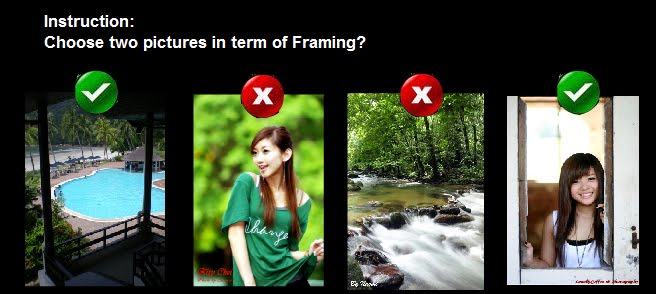
One of the easiest ways to take a creative photograph is to compose your subject with a frame around it. A photographic frame is an object that that acts as a border or frame for your subject. The frame directs the viewer’s attention to a particular subject or point of interest within the photograph. Frames also create perspective and show depth.
4. Balance

Good balance in photography requires the correct combination of colors, shapes, and areas of light and dark that complement each another. By looking at your subject and capture it from different viewpoints, angles or even at different lighting, you can composed a balanced image. Rearranging the elements can also make the wanted effect. And here is a simple tips, try to make a triangular shape from the elements you capture, this will create a sense of stability.
5. Line

Lines can be effective elements of composition, because they give structure to your photographs. Lines can unify composition by directing the viewer's eyes and attention to the main point of the picture or lead the eyes from one part of the picture to another. They can lead the eyes to infinity, divide the picture, and create patterns. Lines can lend a sense of depth to a photograph.
Thursday, February 17, 2011
7th Week: Outdoor Shooting Session



6th Week: Studio Photo Session


Studio photography is capture picture under well-controlling of light such as soft light, hard light, hair light and background. Hard light is generated by a small or far-away light and result in strong shadow. Example of hard lights are the sun(not small but quite far away) and bare bulbs. Soft light is generated by a large diffuse light and results in shadow-free images because there are many paths from the source to the object. Examples of soft light are an overcast sky, a north-facing window close to the subject, a bulb reflected off an umbrella placed close to the subject.
Studio Set Up
Actual we need at least 2 lights : a main light and background light. It is best to use a soft box on the main light, as it will create a much softer light than a umbrella. A background light or a hair light is needed to create separation between the background and the subject. Otherwise, the photograph will look flat. Another light as a fill light would be nice to fill in some shadow. However the reflector will do the job. Or making a large piece of styrofoam or white carboard.
Flash Metering
A device that measure ambient light, light ratio, calculates how many pops of lower-powered studio strobe system. Flash Metering helps us to set our camera to get right exposure.
Umbrella Vs Softbox

The umbrella sends light everywhere, trying to gel a backgroung light with something other. Whereas, softbox sends very little light to the background.
Wednesday, February 2, 2011
4th&5th Week: Lesson & Practical 2

There are many type of lenses. Lenses options from macro lens, wide angle lens, standard lens to telephoto lens. Depends on the usage for the camera novices.
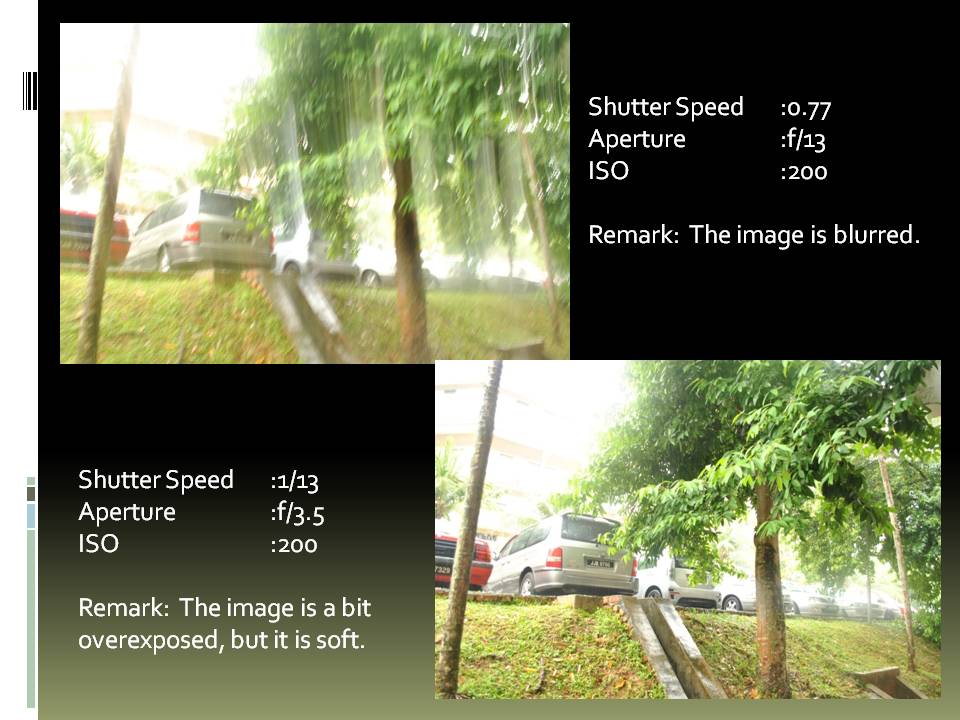
Here is the picture I take for my 2nd handling of DSLR:

Slow Shutter Speed

Fast Shutter Speed

Large Aperture

Small Aperture
3rd Week: Lesson & Practical 1
This is a picture regarding the functional of both aperture and shutter speed:

I am a 1st timer is photography, here are the pictures that I capture during the first handling of DSLR:


Please comment.
2nd Week: Aperture & Case Study
Below image is what I understand about the functional of aperture.
Besides that, Dr. Dayang also discuss on the issue of the differences of the digital compact camera and the DSLR.
As consumers, there are a few aspects we need to consider before purchasing or upgrade a camera.

Case Study 1:
There are huge differences between the little point and shoot cameras and DSLRs. I'm just highlighting some important differences:

1. Image quality.
A DSLR have much better images quality over the point and shoot camera. It produces awesome image qualities especially the pro level cameras.
2. Responsiveness & Performance.
Point and shoot cameras are not designed to be fast and responsive. Most of the recent DSLR can start and operate instantly.
3. Interchangeable lens
All the point and shoot camera has only one build in lens; thus limiting its ability. For DSLR, you can choose the lens to suit your needs.
4. Easy of use
This is the area that point and shoot camera may have the upper hand. Only a click of a button, she got the image taken. For DSLR, the complex menu setting and control system can easily scare camera novices away.
5. Cost and weight
When you have a better product, you normally expect to pay more. This is true too when it comes to camera. DSLRs are generally much better built with better components and software. For point and shoot cameras, it cost less and weight less too.
I hope that I've summarized the major differences between DSLR and point and shoot cameras. Which one to purchase will be determined by how you want to use it.
For more info, please go to http://www.digital-photography-school.com/should-you-buy-a-dslr-or-point-and-shoot-digital-camera